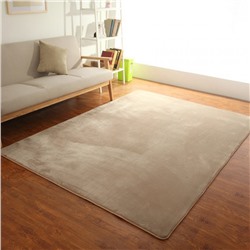
 Carpets are thick mats, mostly woven from wool, with short and dense pile, with or without embroidery. It is used for laying on the floor or on furniture or for stretching to the wall. One of the many exquisite works of art that shows the degree of intelligence and delicacy is the carpet.
Homeland of Carpet
The homeland of carpet is Central Asia. It is inappropriate and erroneous for some authors to show the first homeland of the carpet as an Armenian city called “Kalıklay” or Iran. The first examples of carpet art were found during excavations in Turkestan. Primitive carpets and pieces of colored felt were found among the items unearthed both in the old Turkish homelands called Outer Mongolia today and in the kurgans (mounds) in the Pazirik Plateau between Turkestan and Siberia. The goods in Pazirik are almost intact. Russian writers also say that the first homeland of the carpet was Central Asia. Meanwhile, according to one writer, it was understood that a primitive piece of carpet found in Pazirik dates back 500 years before Christ.
In addition, many small carpet pieces were found in the graves in Noyan Ula. There is no doubt that these carpets are the works of the Hun Turks. It is a known fact today that carpet weaving, which has advanced to the point of decorating the graves of khans, khans and noyans, has been practiced there since ancient times. It was the Turks who took the carpet to China, India and Egypt.
The word carpet comes from “stay”. It means “dowry and mihir given to the bride”. The forms of the word “carpet” in Turkish dialects and in some foreign languages are as follows: Chagatai: “thick”; Crimean language: «kilem»; Turkmen: «kal»; Persian: «kalice»; Kyrgyz: «kilam»; Bulgarian: «haliya»; Czech, Serbian: «halina».
The root of the Turkish word “carpet”, “kali”, undoubtedly comes from the infinitive “kalmak”. Since dowry is something that lasts for a long time, the word “stay” has been used directly in place of “dowry” over time.
Carpet Weaving in Anatolia
Seljuk Turks brought carpet making to both Anatolia and Iran. There are no important pieces left from the first carpets woven in Anatolia. There are places in Anatolia that have gained a reputation for carpet weaving for a long time: Uşak, Gördes, Bergama, Demirci, Kula, Ladik, Karaman, Kırşehir are the most important of them. Carpet making in Isparta, Kayseri, Bor, Sivas and Simav is newer than the ones we mentioned earlier.
We know that pictures of living creatures are embroidered on old Turkish carpets. However, the fact that such pictures were deemed haram later on led to the removal of the picture from the carpets. In the fragments found in Noyan Ula and Pazirik, a dragon is seen holding a deer in its talons. XV. Four imaginary animal pictures are seen on an Anatolian carpet thought to have been woven in the 16th century. This carpet is in the Berlin Museum. It is understood from this that the Turks brought these kinds of paintings from Central Asia and were able to use them in places where religious pressure was weak. In some of the old Turkish carpets, very simple pictures of people and birds can be found.
Carpet Weaving in the World
Carpet weaving from Turks via Iran, VIII. century to Europe. Carpet weaving started in 732 in Southern France, and after this date, carpet weaving developed in Spain and France. Carpet flooring is mentioned for the first time in 992 in English sources. However, the real beginning of carpet weaving in England was XIV. century Flemish carpet weavers III. It begins with an invitation to the country by Edward.
The first to be woven in England were mostly tapestries. XVI. In the 19th century, upholstery carpets were also woven. Bringing Uşak carpets from Turkey also coincides with this period. Already, the development of carpet business in England took place after the Turkish carpets were introduced into the country. In fact, carpets woven as chair covers in the early days were called “Turkey-work” directly. XVIII. When the demand for carpets increased in the 19th century, small factories began to be established.
The first immigrants to America wove carpets on a small scale to meet their own needs. The first carpet factory in the United States was established in 1791 and has grown rapidly since then.
The first carpet factory in France was established in 1626. Very large carpets were woven here and the Uşak knot was used. In 1825, this factory near Paris was closed, the Gobelins factory was opened. The patterns of the Gobelins carpets were paintings.
Carpet Care
A rug will last a very long time if it is well cared for. The biggest enemy of the carpet is moth and moisture. Moths can be prevented by airing the carpet frequently and leaving it out in the sun. If the carpet is to be rolled up and lifted, naphthalene should be sprinkled in between, and it should be opened and ventilated from time to time. There is no moth danger on the carpet used.
Moisture causes the yarns of the carpet to rot over time and to break down in places. In this respect, care should be taken not to keep the carpets that will be stored and used in dampness.
If the carpet is damaged by cutting or burning, it should be repaired without delay. If it is not repaired, the damaged area begins to open and grow rapidly.
Burning or cutting etc. If we leave the accidents like this aside, the most worn parts of the carpets are the edges coming to the door sides and the middle. In this case, a mechanic who understands the job should renew the old places. A master mechanic can completely replace the heavily worn areas in the middle of the carpets. However, this business is quite expensive. In this respect, cheap carpets can also be renewed by replacing the old one with a piece to be cut from another carpet. In fact, sometimes a carpet can be divided into two by removing the old parts.
The effect of dust causes the carpets to lose their color over time. In such cases, it can be washed with hot soapy water and a brush. However, it is necessary to be sure of the quality of the carpet beforehand and to know whether it will throw off the paint. Now special cleaning powders are also used to clean carpets.
 Flooring Systems