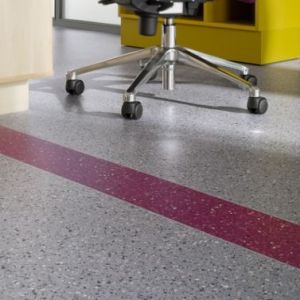
Linoleum flooring is a flexible flooring material produced from natural raw materials such as linseed oil, wood chips, limestone, harmless to human health, and produced in different colors and patterns.
It started to be used for the first time in 1860 with the production of a firm belonging to the Great British Frederick Walton. Frederick Walton built an experimental factory in Chiswick in 1860 where he worked on the oxidation of linseed oil, and received a patent in 1860. He experimented with oxidized oil in place of rubber. He discovered that combining oil with cork and coloring agents produced a useful material for flooring, and he patented this new material in 1863. Walton called this new material “linoleum”.
It is sold in the market in balls 25-30 m long and 2 m wide. Their thickness varies between 2-4.5 mm.
It is made from completely natural materials.
It is a flexible flooring material.
It has antibacterial properties.
Linoleum floor covering price is cheap.
It does not contain harmful substances such as solvents.
It is environmentally friendly as it is produced from natural materials.
It is resistant to cigarette burns, oil and corrosive effects.
It isolates sound and noise caused by stepping on the floor.
It is an economical material.
A wide variety of colors and patterns are available.
It can be adversely affected by humidity and low temperatures.
It is anti-static.
When the new coating is applied, odor may occur due to the smell of linseed oil. It decreases and disappears over time.
It is environmentally friendly as it is produced from natural raw materials such as linseed oil, limestone, sawdust, resin and pigment. It is a long-lasting and biodegradable material.
Let us briefly explain the raw materials used in its production.
FABRIC OIL
Linseed oil is obtained as a result of crushing the seeds formed after the flax plant blooms.
In ancient times, linseed oil; It had different uses such as cooking, lighting by burning, and increasing resistance to water and weather conditions by driving on ship sails.
Today, it is used in the linen industry, in the production of soap and paint, and in the manufacture of linoleum.
wood chips
Sawdust obtained from timber cut from forested lands is added to the material in order to give it fullness. Tropical wood shavings are not used because they are hard.
MUSHROOM CHIP
Cork sawdust obtained by grinding the bark of cork oak provides flexibility and insulation. It grows in countries in the Mediterranean region. Even if the bark of the cork tree is removed, it does not affect its growth.
ROSIN
The resin obtained from pine trees is another material that is a filling element for linoleum. Removing the resin from pine does not affect its growth.
LIMESTONE
Limestone, which is used by grinding very finely for a smooth surface in floor coverings, is a necessary raw material.
PIGMENTS
Environmentally friendly pigments that do not contain lead and cadmium are used, which do not contain harmful substances.
JUTE
The weaving part on the back of the floor covering is made with the fibers of the jute plant grown in Bangladesh and India.
HOW IS THE PRODUCTION MADE?
The following steps are followed in its production.
Resin and linseed oil are mixed in oxidation boilers.
In order to obtain linoleum cement, the oil and resin are oxidized and become a binder by giving air and heat to the boilers.
Other limestone, wood chips and pigments are added to the linoleum cement paste and then wrapped in a jute backing.
In large drying rooms, it is hung to dry in order to gain the necessary flexibility.
It is passed through laboratory and quality tests.
Finally, it is subjected to a water-based surface treatment called ETC to extend the life of the product and make it easier to maintain.
 Flooring Systems